
I’ve had many ups and downs reading James Baldwin’s works over the past six weeks. As I have already said, I really had never done much reading of anything outside of his short stories and non-fiction essays; all of which are fantastic. But over my very small two-week break, I opened an anthology of his novels and really didn’t put it down until I had to be back at work. Actually, to be honest, I also had to put it down when my emotions got the best of me. His writing is a roller coaster not necessarily of ups and downs but of anger, frustration, passion and hope. I won’t say optimism because it’s really not there, but (at least from the perspective of the reader), there is hope. Throughout each novel, I hoped things would change for the characters — that there was some way out of the harsh reality of the United States. But I think as we all know, there is not.
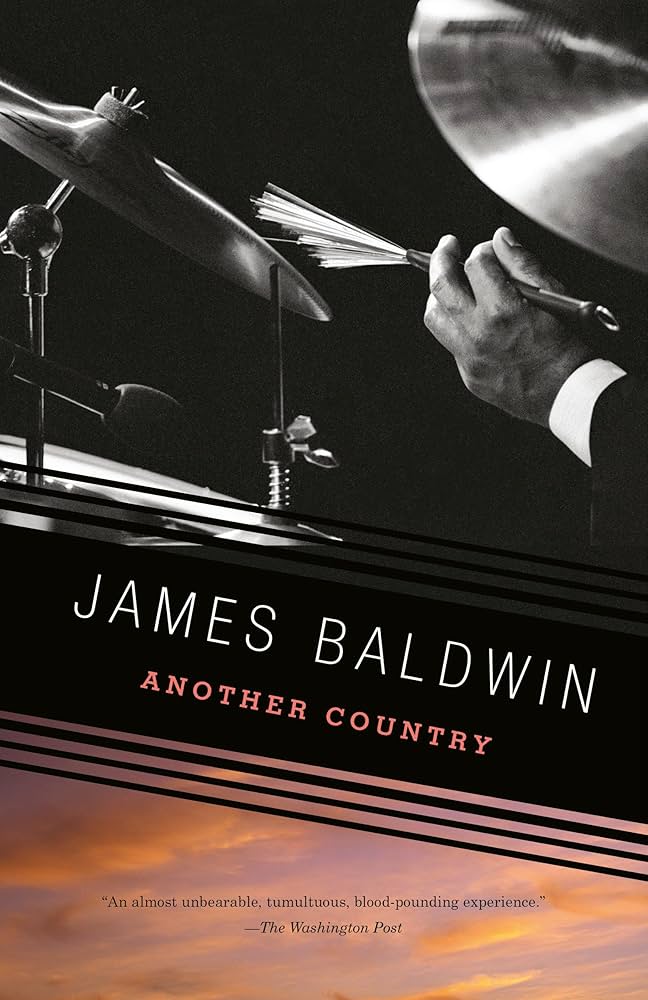
Another Country takes place in late 1950s New York City and the characters include the working class descendants of those southern and eastern European immigrants that came into New York in the last half of the nineteenth century (Vivaldo), aristocratic New Englanders (Cass), and the descendants of African Americans who left the Jim Crow South in the Great Migration of the early 1900s (Rufus and Ida). Themes of sexuality, gender norms and race thread their way through the narrative warning the audience of the dangers inherent in crossing those lines of proper behavior. Transgressions do not come without punishment and each character is tormented by their choices. Rufus who crosses the boundaries both in sexuality and race, ends up throwing himself off the Brooklyn Bridge into the river where he drowns. Cass has an affair with Eric, a queer, white actor from the U.S. South, and becomes the victim of brutal abuse by her husband. Ida and Vivaldo? They are perhaps, to me, the most tragic pair, because they are truly in love and can never get past the scars racism has left on them. This is particularly true for Ida who cannot let go of the way her body as a Black woman has been sexualized, exoticized, and used by white men. Vivaldo, a second-generation Italian immigrant, cannot understand why she cannot let her anger go and he has no way of convincing her that he perhaps is different from other white men. I say “perhaps” because he has also participated in objectifying and using Black women; however, that is not something he is doing with Ida. That being said, I have to emphasize that I’m on Ida’s side here. How in the world are women of color supposed to trust any white man in the United States? That there is absolutely no reason to trust them is shown again and again not just in the novel but in the contextual history the novel brings with it.
I won’t say how the novel ends, but I would like to venture into a tangent for a minute. Throughout the whole book, jazz is front and center. Rufus and Ida are both musicians. Vivaldo loves the genre and supports Ida in all her stage performances (even if he does get jealous of her on-stage presence). Baldwin makes jazz come to life in his words and he brings New York City to life in the way he captures the language of the people hanging out at the jazz clubs. The whole time I was reading this book, I kept thinking of Beat writers like Jack Kerouac and Allen Ginsberg. They are writing in the same kind of rhythm, loving the same kind of music, reaping all the posthumous benefits of having been transgressive and paving the way for a new way of writing fiction. So here’s my observation followed by my question. I would argue James Baldwin is far more transgressive and groundbreaking than either Kerouac or Ginsberg. His musicians, his actors burn so much like those of the Beats. And here’s my question. What might a conversation between Kerouac, or Ginsberg or Ferlinghetti and James Baldwin be like? I don’t know, but I’m curious.
 Patricia Marie Perea