
I don’t like horror movies at all. Really. Most of the horror franchises I haven’t seen since the days of junior high slumber parties (are they still called that)? Every once in a while, I’ll venture into a beautiful, marginally horror film: Bram Stoker’s Dracula (1992), Robert Eggers’ Nosferatu (2024) Guillermo de Toro’s Frankenstein (2025), but that’s as far as I go.* That being said, I will read horror fiction and oddly, I’ll do it before bed. Seriously, there is nothing like having a white noise machine, a reading light, and five layers of blankets to read myself to sleep with. I know, I know. Super sexy, right? Well, at least there’s no cats to finish out the stereotype. JK, they’re in the living room.
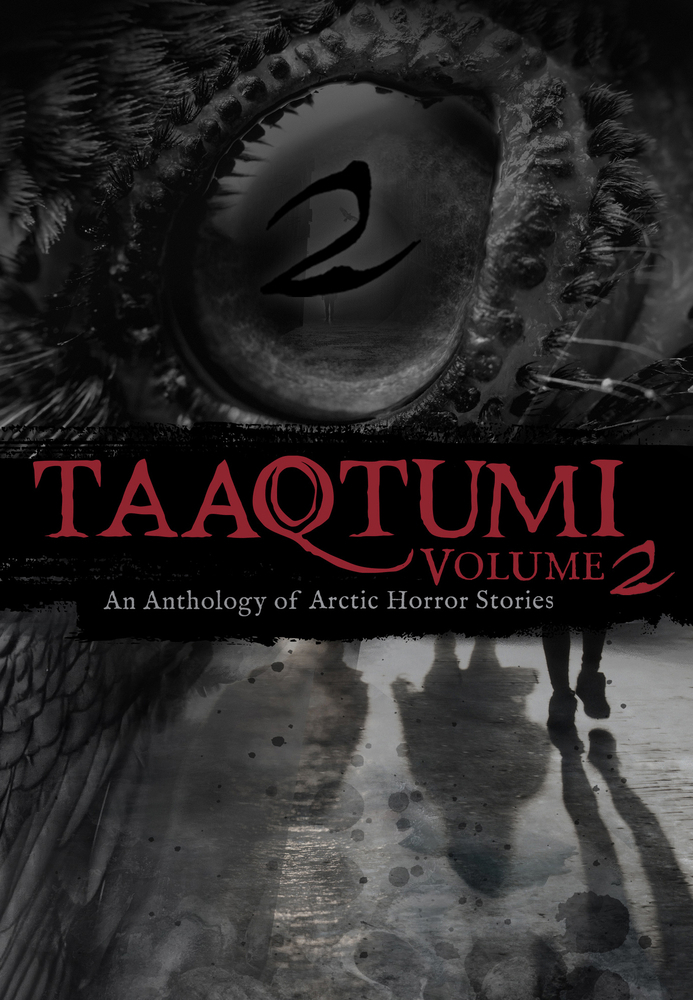
I picked up Taaqtumi based solely on its cover and that I had just seen Blood and Myth plus I’ve always wondered about the stories that might be told during months of night.** I was not disappointed. These stories kept me up past midnight for three solid nights and they were completely worth the lost sleep.
Each story centered itself in the landscape and used it to provide a source of comfort, fear, familiarity and, in the case of AI, destruction.
In “Lounge” by Sean Qitsualik-Tinsley and Rachel Qitsualik-Tinsley, a countdown to whatever “lounge” is structures the outline of the story. It’s clear Talli, the main character is waiting for some type of party, but it sounds ominous af. She’s clearly part of a group of scientists who call themselves “science pirates” and they’re excavating the toxic ruins of an old mine, but what are they looking for? It’s also unclear who is human and who is bot for a while which when I finally figured that out, left me unsettled. I had been reading about a human worrying about bots stealing research? Bots now took the place of our mentors? That’s a joke, or maybe not. Regardless, the only crack in this artificial existence are particles called allons which can influence large patterns of nature. These, Talli believes, are the key to the experiences of her ancestors, but she is angry. Angry because one of her ancestors, her uncle, signed up to let himself be used as a science experiment to pay for her college. The price for her education was his death. As it gets closer to “lounge,” Talli’s colleagues start to concoct their companions for the party, and I have to say some of those concoctions legit turned my stomach, but I’ll leave them for you to discover. And what happens during the lounge party is not pretty either, but even worse is what happens afterwards. I won’t offer spoilers, but I will say the allons and the ancestors are the key to the future.
“Utiqtuq” is heartbreaking. Like so many recent films, television shows, and sci-fi stories, it happens in a post-apocalyptic world. Ijiraujaq/zombies have taken over and only Aliisa a young girl who escaped Iqaluit, Iqtuq, the elder who rescued her, and Anirniq, a toddler who Iqtuq also found are left (as far as they know) in the North. They’re living in the bush on Baffin Island and like any young person, she misses her old life. “They caught fish, dried fish, and ate fish. Alll day, every day.” It has been like this for years until a helicopter and the first qallunaat (white person) they’ve seen in years steps onto the ground. Aliisa, up to this point, thought they were all dead, but the man who identifies himself as a doctor says there is now a vaccine that can prevent turning into an Ijiraujaq and there is nothing to worry about. Aliisa is excited: “Everything was okay now? They could go back to living in a house again? With TV? And a PHONE? Her mind started racing: couches, snacks, food other than seal and fish, showers!” The doctor informs them not only are there vaccines to prevent infection, there are also cures to treat the already infected. He points to his pilot, a former ijiraujaq, as proof. Aliisa gets hopeful. Perhaps her family has been cured. She wants to leave and she wants Ittuq and Anirniq to go with her. Ittuq speaks to her in Inuktitut: “Aliisa, aakuluk, dear . . . you can’t trust this man. I know, I’ve been taken from the land before. They took me from my parents to go to residential school . . . They tried to kill our language, our culture . . . He’s telling you you’re going to a treatment centre for quarantine . . . You’re old enough to make your own decisions, but really think about it. You have enough here, you have freedom. We have a happy life.” Aliisa is faced with a choice. Again, I won’t offer any spoilers here, but I will say the ending is not what you expect.
So, there you go. This is a taste of what kept me up all kinds of late last week and now it’s time to do research to see what more work I can find from these artists.
* I also really love Guillermo de Toro’s Pan’s Labyrinth (2006) and Jayro Bustamante’s La Llorona (2019)
**The film was recommended to me by one of my favorite Native writers.

